


Here are the five components of a healthy soil. Knowing what healthy soil is made of and applying that knowledge will significantly impact the success of our garden and help you troubleshoot any potential problems in the future.
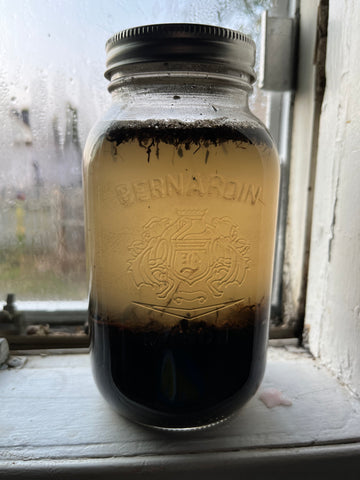
Get yourself a large jar with a lid and fill it up about one third of the way then top the rest of the jar up with water. Shake the jar vigorously and let it sit. After a couple of minutes all of the sand particles will have settled. Mark the level of sand on your jar. Wait two to three hours and check the jar again, the next level of material will be the silt, mark this on the jar. Leave the jar overnight for the clay to settle out of the water and mark that on the jar. After leaving it overnight the water should still be a little murky from the organic matter in your soil, if it isn't then that's a good indicator that your soil requires more organic matter.

Minerals
Organic Matter

Organic matter is fragments of partially decomposed organic matter, such as plant matter, soil micro-fauna, macro-fauna, or droppings left by the soil fauna. Organic matter is only a small volume of your total soil volume, up to ten percent. Despite being only a small amount of your soils volume it is absolutely essential for the moisture and texture of your soil and everything that goes with it. More organic matter is not necessarily a good thing, be cautious with the volume of high-carbon organic matter you put in your soil, like wood or mulch. The microbes responsible for breaking down organic matter will use a lot of nitrogen in the process of breaking down wood. Nitrogen is often the limiting factor of plant growth, if microbes are using it up to decompose the wood you added you're not helping your plants.

The life of your soil greatly depends on your soil life! You want to create an environment where microbes, fungi, nematodes, spring-tails, mites, worms and other tiny creatures can thrive and add value to your soil. These organisms help decompose organic material and convert soil minerals into vitamins and compounds that will nourish your plants.

Water is the final component of your soil and can take up to 25% of the volume. The balance of water in your soil will make or break your garden. Too little water held in the ground will dry everything out. But too much water will fill all the pore spaces, and the proper gas exchange will not take place, suffocating your plants and drowning out soil fauna. Your soil's ability to hold onto water depends on the amount of organic matter present. Organic matter can gently hold the water in the ground without occupying pore space.
The first step, is to determine which type of soil you are working with. Your soil composition is mainly determined by the particle sizes within your soil. The three particle sizes are sand, silt and clay. Sand particles are smaller than gravel, being 0.05-2mm in diameter. Silt particles are 0.05-0.002mm. Particles smaller than 0.002mm in diameter are clay, so small that ordinary microscopes can not see them.
Soil Composition Test
Get yourself a large jar with a lid and fill it up about one third of the way then top the rest of the jar up with water. Shake the jar vigorously and let it sit. After a couple of minutes all of the sand particles will have settled. Mark the level of sand on your jar. Wait two to three hours and check the jar again, the next level of material will be the silt, mark this on the jar. Leave the jar overnight for the clay to settle out of the water and mark that on the jar. After leaving it overnight the water should still be a little murky from the organic matter in your soil, if it isn't then that's a good indicator that your soil requires more organic matter.
Minerals
The mineral component of your soil is composed of bits of rock that have been weathered into small particles. The ratio of sand, silt and clay particles will tell you the type of soil you have and can give you direction on what kind of amendments your soil may need. This is the bulk of your soil and will take up half of the volume of your soil. If your soil is very sandy it will loose water quickly because the pore sizes between sand particles is so large that water will quickly fall through. On the flip side, if your soil is heavy in clay your plants will not have much water available to them as clay particles are tiny and charged so water particles stick to them more tightly than plants can compete with. The ideal ratio of sand, silt and clay is 40:40:20 and this soil composition is referred to as loam.
Organic Matter
Organic matter is fragments of partially decomposed organic matter, such as plant matter, soil micro-fauna, macro-fauna, or droppings left by the soil fauna. Organic matter is only a small volume of your total soil volume, up to ten percent. Despite being only a small amount of your soils volume it is absolutely essential for the moisture and texture of your soil and everything that goes with it. More organic matter is not necessarily a good thing, be cautious with the volume of high-carbon organic matter you put in your soil, like wood or mulch. The microbes responsible for breaking down organic matter will use a lot of nitrogen in the process of breaking down wood. Nitrogen is often the limiting factor of plant growth, if microbes are using it up to decompose the wood you added you're not helping your plants.
Soil Life
The life of your soil greatly depends on your soil life! You want to create an environment where microbes, fungi, nematodes, spring-tails, mites, worms and other tiny creatures can thrive and add value to your soil. These organisms help decompose organic material and convert soil minerals into vitamins and compounds that will nourish your plants.
Air
Your soil needs to be full of air! Pore spaces in your soil are important for your plants to get atmospheric nitrogen, which fuels respiration for the soil fauna that will help keep your plants healthy. Healthy soil can be up to 25% pore space giving you that beautiful and fluffy soil texture. If there is too much pore space in your soil organic matter will decompose too quickly. You want organic matter to slowly break down in your garden, it is not a race, you'll just have to keep adding organic matter, the organic matter is also great at keeping moisture in the soil.
Water
Water is the final component of your soil and can take up to 25% of the volume. The balance of water in your soil will make or break your garden. Too little water held in the ground will dry everything out. But too much water will fill all the pore spaces, and the proper gas exchange will not take place, suffocating your plants and drowning out soil fauna. Your soil's ability to hold onto water depends on the amount of organic matter present. Organic matter can gently hold the water in the ground without occupying pore space.
When you pay attention to and consider all these factors of your soil, you're bound to notice where your soil can be improved and in the long run, you'll learn more and your harvests will benefit greatly!


Bobby
Will try this
Lois
Interesting
saundra
I have top soil in my flower boxes.
Would veg. scrapes be organic? I am canning tomatoes, green beans, peas, shells of the peas and eggplant etc. Thank you for good information.
Northern Wildflowers
For sure. This is more of a blog on the physical properties of a healthy soil and a DIY soil test you can do at home to understand the make-up of your soil.
Robert Raimo
Nice bit of info. Mentioning pH would be useful, without staying in an appropriate pH range many minerals are not available to plants. R R Raimo, soil scientist.